Friday, July 8, 2016

Morning on Nippenicket


Here it is July and I've only just gotten a kayak in the water!  It was a busy few months.  I decided yesterday would be a good morning (not too hot) to catch up on the happenings at a local pond.  "Lake Nippenicket" is a mile-long pond that has it all: an interesting shoreline, a couple of little islands, lots of pond plants; the southern half has waterfront properties (I like to paddle along and peer shamelessly into people's backyards), while the northern half tucks into the wilds of the great Hockomock Swamp. Most often I noodle slowly along the shoreline, pausing to look at flowers and birds.  My boat this day was Musketaquid my twelve-foot homemade skin-on-frame kayak.


 My Merlin bird ID app from the Cornell Lab of Ornithology 
pegged this bird pretty quickly as an Eastern Kingbird.

 The round flower heads of buttonbush (Cephalanthus occidentalis).

In one place the air was alive with electric blue dragonflies damselflies doing what dragonflies are meant to do.  Several pairs rested on my paddle blades--even refusing to move when I began to dip a blade in the water.  (Several shallow strokes left this pair unimpressed.)  I didn't get far until they finally decamped. 

Whoops!  I just notice these kids have their wings folded over their backs, rather than 
outstretched like an airplane: that makes them damselflies rather than the related dragonflies.  
They look like Northern Bluet damselflies (Enallagma cyathigerum).  
(Mind you, all I really know about damselflies is the name of the group!)

 They can even fly in the act of mating!


Soon after leaving the damselflies behind, the air filled now with dragonflies!  A dozen mated pairs flew about, many repeatedly dipping their abdomens in the water (likely laying eggs)--while flying in tandem!  None rested on the boat, so all I could see is that these were a medium golden-brown color. 

 I quietly chased this mama mallard and three ducklings ashore
in an effort get close enough for a picture.

I like to imagine living in these places, with their varied ways of enjoying the pond.

 White water lilies (Nymphaea odorata).  Floating leaves are nearly round.

 Yellow water lilies (Nuphar advena).  Floating leaves are more oval, and larger than white lily.
 One of the little islands.

 white water lilies line the shallows.

 Passage between the mainland and a small island was a squeeze even for a little kayak.


 The water level in the pond is a bit low for this time of year because it's been so dry.  
The water ranges over about a foot of depth.  

This was the first time I noticed the hollow in the top of the rock.  It has its own tiny ecosystem.

I paddled back a little before noon, very happy with my morning!

Wednesday, July 6, 2016

Gypsy Moths are (done) Pupating

Gypsy moth pupae in white pine, black oak, and white oak.

A few days ago I first noticed a white pine with caterpillar pupae--I counted sixteen on one small branchlet.  Today I found oaks and maples with leaves bunched and curled around many more pupae.  That means we will see a lot of adult gypsy moths--smaller brown males, and large, white flightless females--in two weeks or so.  (Probably not all the caterpillars around here pupate at the same time: my wife noticed numbers of moths flying around the high school.)  

Adult gypsy moths live only about a week, and their sole aim is to mate.  The large female will attract a male with a powerful pheromone.  (One environmentally-friendly way to combat an infestation from year to year is to decoy the males with synthetic pheromone, which is specific to this one species.)   A single female will lay perhaps five hundred eggs in a patch covered with peach-colored fuzz on tree trunks, rocks or other surfaces.  The eggs overwinter and hatch in spring.  The tiny caterpillars then disperse on silken threads like the baby spiders at the end of Charlotte's Web.

What signals the caterpillars to pupate?  Do they need to reach a certain size, or begin to run short of food, or is there a certain triggering temperature, or a certain day length?  Since the adults live such a short time, whatever the trigger is should be experienced at about the same time by all the caterpillars in one region-- anything more idiosyncratic would spread out pupation and leave early and late moths at risk of finding no one to mate with.  

What will next year bring?  I may invest in some BT (Bacillus thuringiensis) bacterial insecticide and a sprayer.  I know from experience that a little hand-pump sprayer can't reach the tops of tall trees, but it's something to try.

UPDATE: my son spotted moths laying eggs right in our yard the next day.  

 The mate for one of the females is still there.

 I wouldn't imagine white would make sense as protective coloration,
but it seems to work for these moths.  (At least until they begin laying eggs.)

 Spotted a female just emerged in a white oak.  I guess pupation is about done; lots of males fluttering about.
 

Saturday, July 2, 2016

What do Gypsy Moth caterpillars like to eat?

Given that most caterpillars don't travel very far from where they were born, a better question might be: "what trees do gypsy moths lay their eggs on?  I suppose, since the female moths are flightless, these might amount to the same question after all!  Only in the last week or so have the local papers been really interested in the outbreak--possibly the worst in southern New England since 1981.  Of course, now the damage is done, and caterpillars are about ready to pupate.  We will be dealing with the moths in a few weeks.  

 (I remember having, as an undergraduate, the surreal experience of hearing the patter of raindrops (really frass) in bright sunshine where no sunshine should reach: the middle of an oak forest.)  Here, at least, the damage does not compare to that of 1981.  

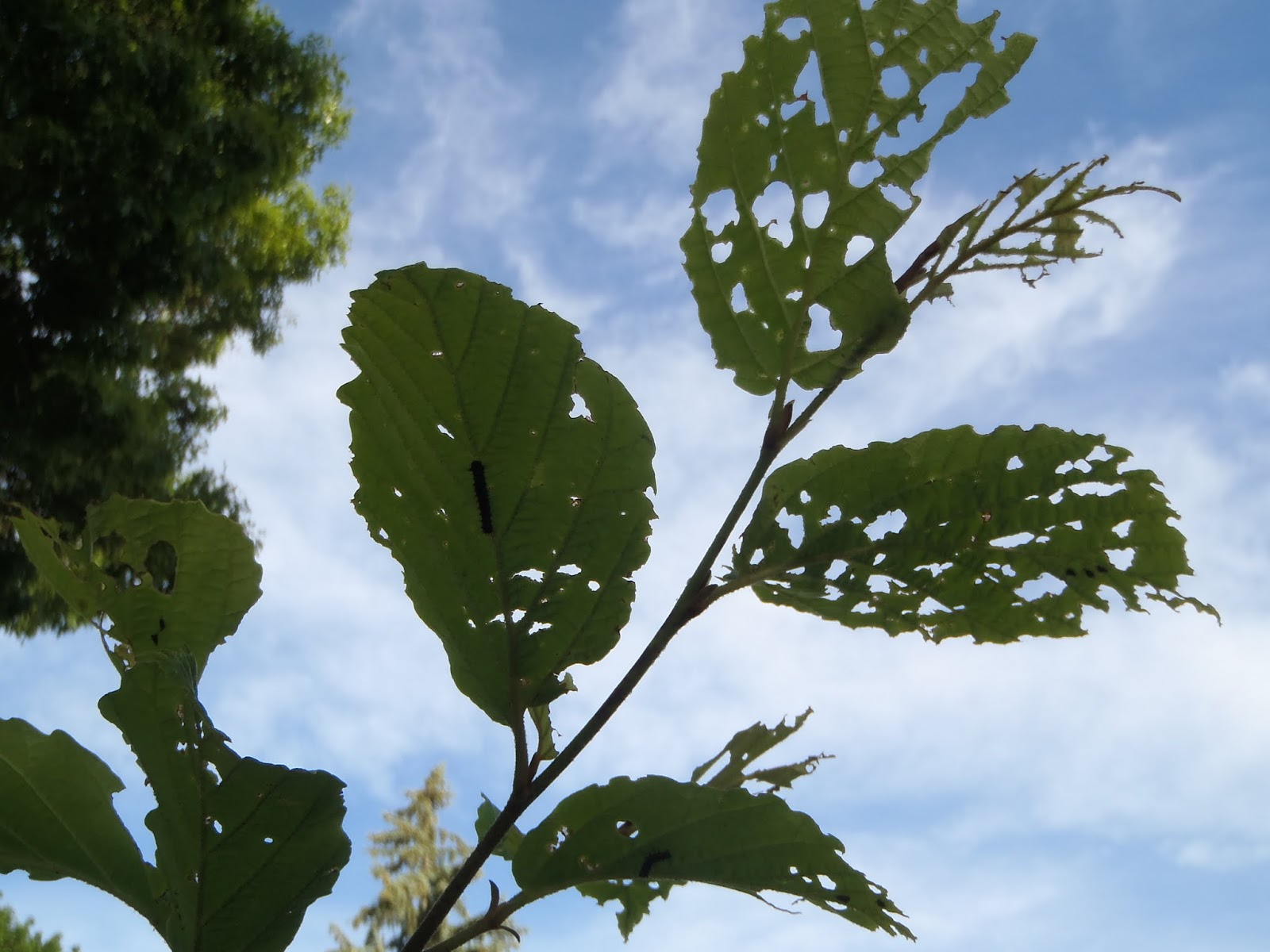
This witchhazel has been hit pretty hard.  This is the only individual 
of this native shrub I know nearby, so its hard to say how general the damage is.

White oak is supposed to be a caterpillar favorite, but damage seems to be moderate here.  
But this may be mere appearance: white oak can put out a new suit of leaves pretty fast

The river birches have been hit pretty hard, but are recovering.

Black oak has suffered at least as much damage as white oak, and is at least as heavily infested.

The big surprise to me: I didn't see any damage to white pines, but suddenly there are tons of caterpillar cocoons in one neighborhood tree; maybe the damage is too high up to be easily visible.

Some trees appear to have suffered little damage.  (Appearances can be misleading: sometimes a tree looks good because it is able to produce new leaves as fast as caterpillars eat them.)

What do Gypsy Moth caterpillars not like?  


They appear to have no use for white ash.  Most ashes around the neighborhood
have leaves in pristine condition.  I haven't seen caterpillars in any ash trees. 

 Pignut and shagbark hickories are also mostly in very good shape.

 Quaking aspen suffered some damage early on, but has mostly recovered.