I was just about to talk about the long period of late winter and early spring when nothing much seems to be happening in the plant world, when I came upon a twig on the sidewalk. Silver maple, I was pretty sure. Positively packed with swelling buds, as usual. And did I see flowers peeking out of a few? Already?! And in WINTER, for God's sake! Last year silver maples didn't flower until the beginning of April, more than four weeks later!
Over the next day or two I paid a visit to every silver maple I knew about, and also a good many quaking aspens, which bloom at about the same time as silver maple. Sure enough, silver maples are popping more than four weeks earlier than last year, and quaking aspens aren't far behind. The prolonged warm weather we've had lately is probably to blame. How?


This early flowering was caused mainly by a fluke of the weather. But over the long term we should expect plants to flower and leaf out earlier in a warming world. This has consequences that could prove disastrous. For example, a British bird called the great tit depends on a good supply of winter moth caterpillars to feed their growing chicks. The winter moths, in turn, eat the leaves of English oak. The birds have always laid their eggs at the right time so that caterpillars are at their peak just as the chicks are at their hungriest. However, warming climate has led to earlier growth for the oaks and caterpillars, while the birds have been left behind. Laying their eggs too late, the birds fledge fewer and lighter young, putting stress on the great tit population. It bodes ill that most species studied so far react differently to climate change than the species they depend on.


Over the next day or two I paid a visit to every silver maple I knew about, and also a good many quaking aspens, which bloom at about the same time as silver maple. Sure enough, silver maples are popping more than four weeks earlier than last year, and quaking aspens aren't far behind. The prolonged warm weather we've had lately is probably to blame. How?

Silver maple (Acer saccharinum) on Moraine St almost in full bloom on 2/29.


Silver maple on Tuesday, 3/1. The white filaments sticking out all over are stamens shedding pollen.

Pussy willow at the high school.

Some of the quaking aspen (Populus tremuloides) buds above look larger than their neighbors
because they are expanding to flower. Below are unopened buds.


Quaking aspen at the top of my street is almost in full bloom on Tuesday 3/1.
Why the early blooming?
Trees go dormant in winter on a schedule fixed roughly by the length of uninterrupted darkness. (By interrupting darkness, streetlights sometimes play havoc with tree life cycles.) When nights become long enough in the fall, processes are set in motion that cause leaves to turn color and drop, and dormancy to begin. But dormancy doesn't end according to night length: instead, the tree must experience a certain minimum number of hours of sufficiently cold temperatures. Just how cold, typically a little above freezing, and for how long, depend on the tree species. This cold requirement reduces the chance that a tree will become active and grow leaves and flowers during an early thaw, only to be killed by a later cold snap. But once the tree has clocked the required number of cold hours, any prolonged warm spell can break dormancy and send the tree into action for the new growing season.This early flowering was caused mainly by a fluke of the weather. But over the long term we should expect plants to flower and leaf out earlier in a warming world. This has consequences that could prove disastrous. For example, a British bird called the great tit depends on a good supply of winter moth caterpillars to feed their growing chicks. The winter moths, in turn, eat the leaves of English oak. The birds have always laid their eggs at the right time so that caterpillars are at their peak just as the chicks are at their hungriest. However, warming climate has led to earlier growth for the oaks and caterpillars, while the birds have been left behind. Laying their eggs too late, the birds fledge fewer and lighter young, putting stress on the great tit population. It bodes ill that most species studied so far react differently to climate change than the species they depend on.
Food chain being stretched to the breaking point?
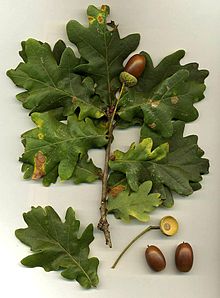
Great tit, English oak, and the winter moth and caterpillar.
(All photos from Wikimedia Commons.)


