Showing posts with label Populus tremuloides. Show all posts

Saturday, March 25, 2017

Essential Differences

Heard a bluebird about a week ago.  There are very few phenomena which can be described indifferently as occurring at different seasons of the year, for they will occur with some essential difference.  Journal, Nov 3, 1853

Henry David Thoreau's attempt to made a detailed seasonal nature calendar was probably doomed.  After my own "years of observation," I am astonished at how variable events can be.  Not only do the early-blooming trees vary year to year by more than a month, these trees have not been varying together, but each following its own mysterious impulses.

Henry David Thoreau is well-known among modern naturalists for his close, systematic, and long-continued observation of nature in his hometown of Concord, Massachusetts.  Among his ambitions was to record the events of nature precisely enough to predict--almost on a daily basis--the flowering and fruiting of plants, arrival and departure of migrating birds, mating seasons, and other events of the season.  Although Thoreau's interests varied from year to year (one year he hatched and followed snapping turtles), he did one concentrated, conscientious "year of observation" around 1852 in which he determined to record every seasonal event.  He was building his own version of the seasonal calendars that were popular at that time.

I have been doing my own "years of observation" in my own little neighborhood over the last three years or so.  The wild swings of the last few springs have convinced me that nature is predictable only within wide limits.  Last year the warm winter brought out the early-blooming trees far earlier than the year before.  This year we had another warm winter--one of the warmest Februarys on record worldwide, and definitely the warmest ever in this region--and I looked for the same trees to bloom at about the same times as last year.  To my surprise, some bloomed earlier, but some bloomed later.  So nature is still less predictable than I'd thought. 

Silver maples began blooming April 4, 2015, but February 29, 2016 and February 23 this year!

Quaking aspens bloomed around April 10, 2015, but March 26th, 2016, and was in full bloom before March 22 this year.

 Red maples bloomed April 15, 2015, but March 11, 2016, and is just beginning to bloom as I write on March 25th.  (Males above, females below.)

But maybe it's better this way.  A predictable Nature would be a boring Nature.  In truth, the closer you look, the more Nature remains full of surprises.

Sunday, March 27, 2016

Quaking aspen finally flowering

Quaking aspen (Populus tremuloides) makes one of the earliest moves in spring, producing catkins like the fuzzy things on pussy willow.  (Aspens and willows are in the same family.)  But it has taken until now for those catkins to lengthen into dangling flower clusters and get down to business.  My visit to the weedy stand of trees at the edge of the empty parking lot (beside D'Angelo's) at the top of West St. yesterday showed good many catkins shedding pollen.  This pollen drifted off on the breeze to (hopefully) female flowers on other trees, ensuring future generations of quaking aspens on the west side.  (A place to look for bigger trees is the edge of Poliseno Field at the high school.)

Many buds had opened to reveal downy catkins more than two weeks ago.

What the catkins looked like inside: each tiny green bump is a single flower; 
a catkin has many hundreds.

 Yesterday the lengthening catkins were shedding pollen as they swayed in the breeze.


Flowering catkins up close.  The buds always seem to me to look like shiny brown beetles.

 
I help spread the pollen!  See it drifting off?

Meanwhile, the alder at the high school pond is about done (the male catkins dried out and darkened), silver maples (Acer saccharinum) have dropped their male flowers, leaving the females to develop their winged seeds, while red maples (Acer rubrum)--including later-blooming males--are now in full flower.  I was surprised yesterday to come upon a couple of yews (bright green evergreens with broad, flat needles often pruned into yard bushes) shedding pollen from little, ball-shaped cones.  I hadn't realized any local conifer* "bloomed" this early.  

The alders on the banks of the high school pond look dried-out--not like a week or so ago.

 Fallen male silver maple flowers, and remaining female flowers.


 Red maple female flowers (above), and male flowers (below).

 Though commonly planted and pruned, yew (Taxus canadensis) is a native tree.  
The little yellow balls are male cones shedding pollen.

*If you've seen the juicy, bright red "berries" of yew in fall, you'd be entitled to doubt it was a conifer at all, but each "berry" surrounds a tiny round cone.  Another conifer that disguises its cones is juniper, which coats its tiny, berry-like cones with blue-white wax.

Tuesday, March 1, 2016

Early Bloom

I was just about to talk about the long period of late winter and early spring when nothing much seems to be happening in the plant world, when I came upon a twig on the sidewalk.  Silver maple, I was pretty sure.  Positively packed with swelling buds, as usual.  And did I see flowers peeking out of a few?  Already?!  And in WINTER, for God's sake!  Last year silver maples didn't flower until the beginning of April, more than four weeks later!

Over the next day or two I paid a visit to every silver maple I knew about, and also a good many quaking aspens, which bloom at about the same time as silver maple.  Sure enough, silver maples are popping more than four weeks earlier than last year, and quaking aspens aren't far behind.  The prolonged warm weather we've had lately is probably to blame.  How?

 Silver maple (Acer saccharinum) on Moraine St almost in full bloom on 2/29.

Silver maple on Tuesday, 3/1.  The white filaments sticking out all over are stamens shedding pollen.

 Pussy willow at the high school.

 Some of the quaking aspen (Populus tremuloides) buds above look larger than their neighbors
because they are expanding to flower.  Below are unopened buds.

Quaking aspen at the top of my street is almost in full bloom on Tuesday 3/1.

Why the early blooming?

Trees go dormant in winter on a schedule fixed roughly by the length of uninterrupted darkness.  (By interrupting darkness, streetlights sometimes play havoc with tree life cycles.)  When nights become long enough in the fall, processes are set in motion that cause leaves to turn color and drop, and dormancy to begin.  But dormancy doesn't end according to night length: instead, the tree must experience a certain minimum number of hours of sufficiently cold temperatures.  Just how cold, typically a little above freezing, and for how long, depend on the tree species.  This cold requirement reduces the chance that a tree will become active and grow leaves and flowers during an early thaw, only to be killed by a later cold snap.  But once the tree has clocked the required number of cold hours, any prolonged warm spell can break dormancy and send the tree into action for the new growing season.  

This early flowering was caused mainly by a fluke of the weather.  But over the long term we should expect plants to flower and leaf out earlier in a warming world.  This has consequences that could prove disastrous.  For example, a British bird called the great tit depends on a good supply of winter moth caterpillars to feed their growing chicks.  The winter moths, in turn, eat the leaves of English oak. The birds have always laid their eggs at the right time so that caterpillars are at their peak just as the chicks are at their hungriest. However, warming climate has led to earlier growth for the oaks and caterpillars, while the birds have been left behind.  Laying their eggs too late, the birds fledge fewer and lighter young, putting stress on the great tit population.  It bodes ill that most species studied so far react differently to climate change than the species they depend on.


Food chain being stretched to the breaking point?
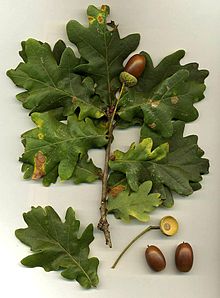
Great tit, English oak, and the winter moth and caterpillar. 
(All photos from Wikimedia Commons.)
Quercus robur.jpghttps://upload.wikimedia.org/wikipedia/commons/e/ef/Great_tit_side-on.jpg


Operophtera brumata01.jpg


Tuesday, May 19, 2015

Spring 3a

I've been keeping up pretty well with spring's progress this month, but not so well with communicating it.  I'll let the pictures do the talking, but there are so many, I'm going to break "Spring 3" into several parts.

First, the leaders.

Across from the little male trees at the high school is a row of stately female quaking aspens (Populus tremuloides).  Long after the males had dropped their spent flowers, those of the females were maturing into fruit. These were opening to shed silky, wind-borne seeds by May 14th.


Black cherry (Prunus serotina) hasn't flowered yet, but it's one of the earliest trees in the neighborhood to leaf out.  The flower buds are just about to break.


 May 11th (2), 13th and 16th.

Monday, April 27, 2015

Spring 2


First the scientific stuff.  Flowering times this year are running about a week behind last year's, so far.  (About which more in a few days.)

Red maple bloomed on about April 15, and you can see its progress here from 4/21 to 4/25.


The black cherry that was still in bud on April 11 and 15th, began breaking its buds on the 17th and leaves are expanding on the 25th.


Silver maple finished flowering before April 18th, since most of the male flowers had dropped by then; the fruits are developing from the 21st to 25th, and leaves are emerging. 


The lovely sugar maple on the corner finally began bud break on about April 21st, and here its flowers open over a period of almost a week.  Binoculars show stamens out by the 25th, though they are not visible in the last photos. 


Norway maples were still in (swollen) bud on April 17th, but their buds began breaking on about the 21st, and flowers were open on my yard tree today, the 27th.


This oak (likely black oak) was still firmly in bud on April 8th, but these began breaking on the 21st, and the male catkins had begun to elongate by the 25th. 


A visit to my parents a few days ago shows progress there.

 My parents' yard in Rhode Island has tuliptrees (Liriodendron tulipifera)
among natives,and resident aliens forsythia and magnolia. 


Finally, a walk around the high school grounds today, April 27th.

 Oak, probably black oak.

 Possibly crabapple; something in the Rose family, in any event.

To multiflora rose, among the first to leaf out and last to drop leaves, I 
grant the status of Honorary Native.
 The male red maple flowers have shrivelling stamens, so their end is near.

 Another crabapple.

 This lovely shrub, silverberry (Eleagnus umbellata) early puts forth leaves
covered with silvery and highly-reflective scales.  Flower buds are also visible.